Random Projects – The Quibi Commercial

Over the years I’ve had the opportunity to work on all kinds of different projects … the other day someone was talking about Quibi and it reminded me of this one.  We did a little commercial that sold the idea of how fun short content on the Quibi platform would be.  

This was late 2019 and we were animating at Titmouse, contracted by the Mill (back when they still had an LA office).  The Mill would handle boards / animatic / designs and the agency communication.  Titmouse would tackle all the animation, compositing, post editing and exports.    Style wise it was supposed to look like Jay Ward animation and directly references Dudley Doo Right and Snidely Whiplash – only instead of the damsel on the railroad tracks, it ends up being our cowboy.

We got to work with one of my favorite animation directors, Mike Carlo, collaborating with the New York Titmouse studio.  The compositing and editing were done back at Titmouse Los Angeles.  Mike Carlo and I have gotten to do a few projects together over the years and he is incredibly great at problem solving and adjusting while still making the animation look fantastic (and just an all around amazing animator).

We had a tiny budget (there were just 4 of us), a quick schedule and things were changing constantly (as they often do on these things) – characters would change (the cowboy was a different character originally), dialogue changed, composited footage changed, backgrounds changed.  Basically over the course of production, everything that could change, did change (often more than once).  Nothing would lock until the last second and everything was wet clay up until delivery.

We also had the added challenge of delivering two different versions – landscape (9×16) and vertical (1×1).  That meant separate crops, tweaks and exports – you’re doing everything twice on the back side.  That was a new idea at the time that Quibi was trying to capitalize on – content that worked full screen no matter how you held the phone (vertical or horizontal).

Related side note – Back around 2003-2004 when we switched to “HD” from 4×3, we had a somewhat similar problem – formatting to keep action inside tv safe on the 4×3, while trying to populate the edges of the screen. So they ended up exporting two versions – one for people still watching on old traditional 4×3 tv’s and a widescreen version for people on what were then known as “HD” tv’s. If you watch shows from this era, you might see lots of dead space onscreen on the sides, and this is why.
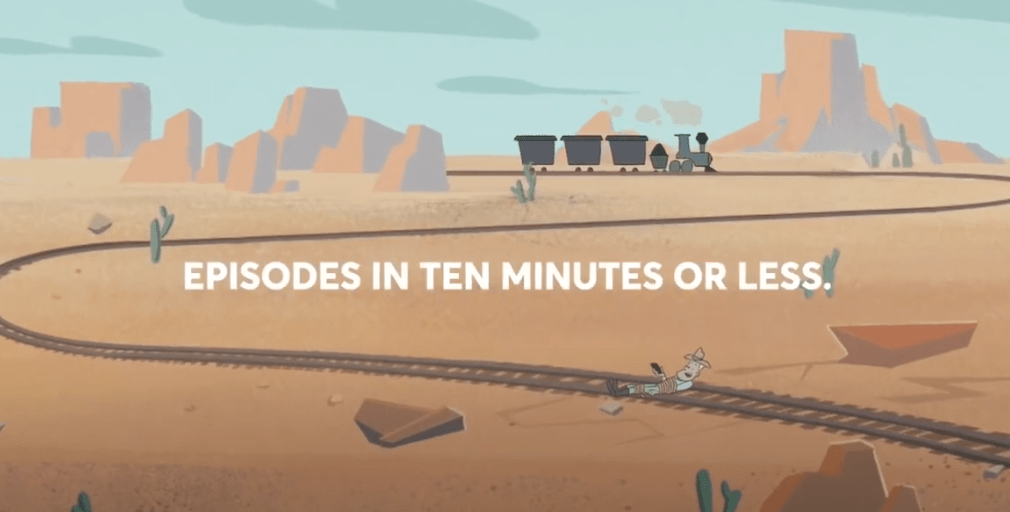
End of the day, we got it done, our compositor cursing at us all the way with our last minute changes from the client.  Looking back on it now, it’s maybe a little simple, but for the limited time and money (and all the changes we had), it turned out pretty great. I vaguely remember seeing this run during some tv network sports games, so it got out into the wild and saw some distribution.

One of the things I learned on this commercial (and continue to learn on small projects) is practicing flexibility.  Doing things out of order and changing content constantly during production can drive you crazy – your job is to slow down, think through it, and adapt.  This one was small enough that it never got out of control and I could learn HOW to adjust on the fly.  We had great collaborators at the Mill who were there with us through it all.  Finally, if you have a great partner to help you in your quest (like Mike Carlo was for me on this one) you can get through the craziest situations and come out with great work.

Parting thought – Funny that Quibi as a concept / company didn’t do well, but here we are all constantly watching IG / Youtube / Tiktok / etc shortform content 6 years later and everyone’s attention spans have likewise eroded.  People make fun of the execution of Quibi, but it may have just been too far ahead of the curve with not enough runway – clearly the idea works on some level.

Here’s the commercial!

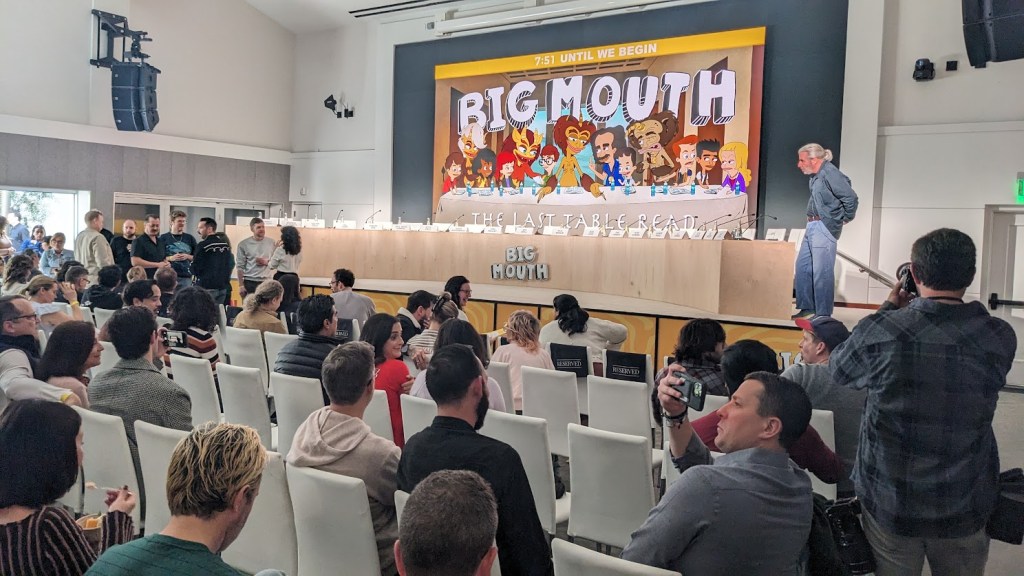
Big Mouth – The Last Table Read

The writing team for Big Mouth conducts table reads to evaluate scripts with a live audience. For season 8’s final episode, Netflix hosted a celebratory event with cast and crew, marking a shift from remote reads due to COVID-19. The event captured the chemistry of the cast, resulting in a memorable behind-the-scenes video release.

One of the things we do as part of our writing production on Big Mouth is table reads – a process where we all get together and the talent and writers to do a real time read through of the script.  Many primetime adult comedy animated sitcoms do this exercise – one that is labor intensive and expensive, but typically worth it.  This is a good way to pressure test the script and see what’s working and what isn’t with a live audience.

For Big Mouth season 8, to celebrate the final episode table read, Netflix put together a big internal event at the Netflix animation studio with a large audience where we invited many more people than a normal table – family, friends and lots of people who had worked on the show over the years.  Even though this was back in 2024, the majority of our table reads from 2020-2024 had actually been remote / zoom tables since Covid.  Something we initially thought would be temporary, ended up being over 50 zoom tables!  Ending this show with a giant table read was a fantastic celebration for the cast, crew and Netflix.

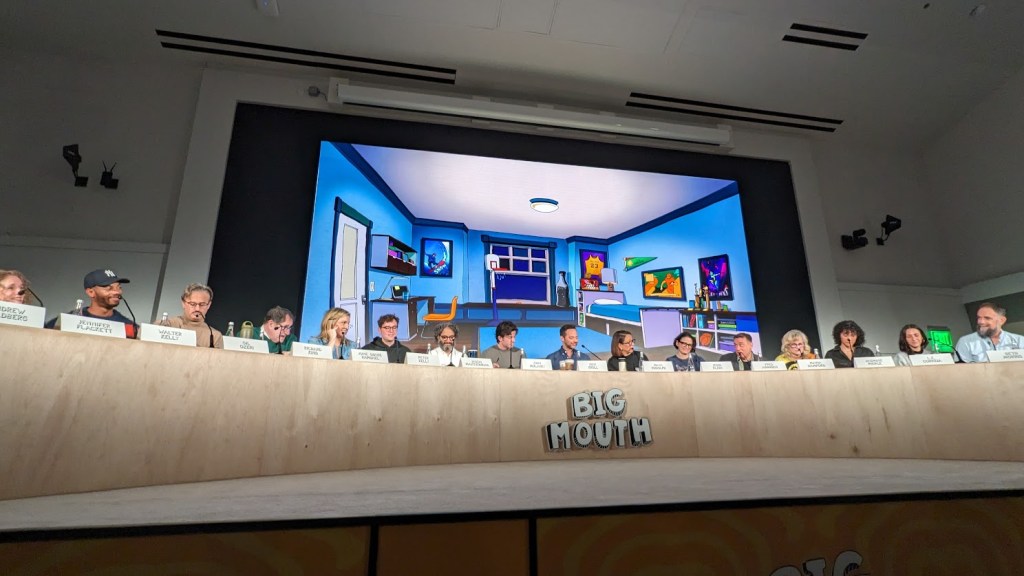
In many table reads, it’s difficult to gather all the cast (or even the majority of them) for any given episode – everyone is off working other projects, busy shooting and you are doing these table reads usually twice a month.  When that happens, you have other talent or (more often) writers fill in the roles for any missing talent.  This being a big event, we managed to secure most of the talent for the episode and it’s amazing to see all those actors in one place!

Some of what you get to see with a live table read is the cast interacting with each other, messing around and enjoying the script.  I think everyone there knew how special this moment was – there was a kind of magic in the air.  It’s fun to watch this and see the actors riffing off each other and doing improv – we try to capture as much of that chemistry as possible in the record and hopefully it comes through in the final product.

I remember seeing them having cameras set up and filming the table read, but we weren’t sure what was ever going to be done with the footage.  Here we are over a year later and they released a video of the table read to the public as part of the promotion for the final season.

It’s a cool behind the scenes look at what was a very special event and something that most people would never get a chance to see, so I’m glad it’s out in the wild for everyone to watch.  

If you do end up watching the table read, you’ll get to see a peak behind the curtain at the beginning as Mark Levin (one of the creators of the show) does an intro to the table and talks about the history of the show along with some funny stories about executive notes and cut scenes that couldn’t make it into the series.

Also a nice article from Variety here about the last table read.

Move Slow and Follow Rules

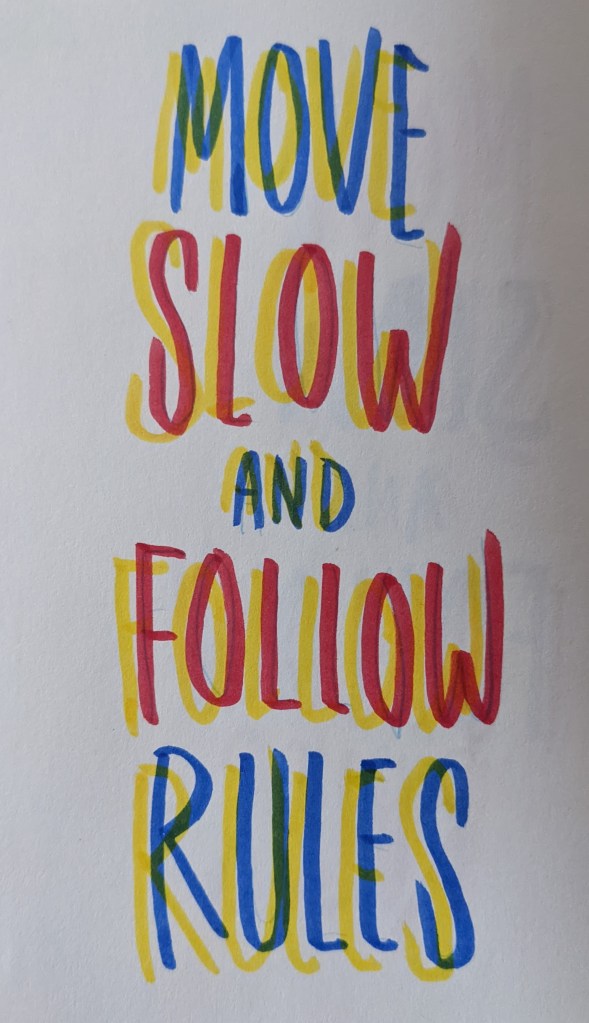
I tried to think of what would be the opposite of ‘Move fast and break things’.  Zuckerberg’s often quoted ideal is interpreted (or misinterpreted) a thousand different ways.  I like the simplest interpretation – challenge things, try a lot of stuff and fail fast (so you get to the ‘right’ solution faster).

Seems like a sign that you would see hung up by a public pool

“Move Slow and Follow Rules” probably isn’t a good thing to automatically put in play – seems like almost a default setting we often see on most productions.  

Move slow and you get less done.  Sure there are times you need to move slow. You need to probably move slow if you are learning.  You might also need to move slow(er) if accuracy or quality is not at spec.  If neither of those are at play, you should consider moving faster (generally speaking, people could embrace a little more urgency on most shows).

Carefully follow your established rules and you will likely get the same results.  Sometimes, you want the exact same results (assuming things are going well and high quality), but most times we want better results and linked improvement.  You get that from small iterations, adaptations to the rules.  You want exponential results?  You better be ok with breaking some things.

‘Move slow and follow the rules’ is a good thing to tell the novice, someone inexperienced, or someone struggling with quality.  Otherwise, I’m always going to recommend we take a good look at things, move faster and adapt.

BTW – Stay Out of the Way

Advice to Managers – Stop monkeying with the machine

Here’s what I tell most new managers – let’s call it proactive guidance.

If a crew is running well and morale is good, then stay out of their way.

If you want to do something (if you feel like you aren’t contributing enough), then figure out how to make your crew’s life easier. Start by listening and watching.

Get them better tools / resources OR clear roadblocks for them. Often young leaders think they always need to be involved – they tend to micromanage to either assert their position or to feel useful. This is a mistake.

Sometimes crews might actually need training, but more often it is just a nudge that’s needed. Unless the wheels are falling off the cart, training may not be the move. Just keep them pointed in the right direction.

The skipper lets the crew do their job and stays out of their way so they can do it well. She watches the crew to see where they need help and continues scan the horizon making sure they are headed the right way.

There Are No Secrets

He will steal all your secrets…

Just so you know, there are no secrets.

Sometimes people think there is some sort of secret schedule, technology, pipeline, budget – whatever specific target you want to imagine is the root cause why a show works.  

“If I could just get my hands on that budget…”  Well, if you did, you would probably find a few items that were a small surprise, but it will just be a normal budget.  No secrets – it’s not unlocking the mystery of production.

It’s the equivalent to saying, “If I just had Tiger Woods’ clubs, I would be much better at golf.” That’s an obviously ridiculous statement.

People visiting the studio love taking pictures of our schedule on the show, finding out how many crew we have, or writing down how many weeks we spend doing something – as if having that equation would be the secret.  It’s not a secret.  It’s just a solution to a problem.

Each production has problems – to critically evaluate each project and apply the correct amount of time and resources and pair the plan with the right talent, that yields the CHANCE to make something great.

Being skilled at analyzing and predicting allows you to be able to make these models tighter and more accurate.  It also helps if you have put in some mileage so you have the needed references.

Applying the wrong model to a project aimlessly because it was proven to have worked somewhere else will typically yield poor results.  If you happen to see this slowly becoming apparent mid production, it might be time for a pivot (if anyone will listen).

Get input from the right people when building out new projects, but don’t worry about the ‘secrets.’  If anything, it might lead you into a false sense of security.